【1】获取变量的类别:两种方式:
(1)reflect.Type.Kind()
(2)reflect.Value.Kind()
【2】Kind的值是常量值:
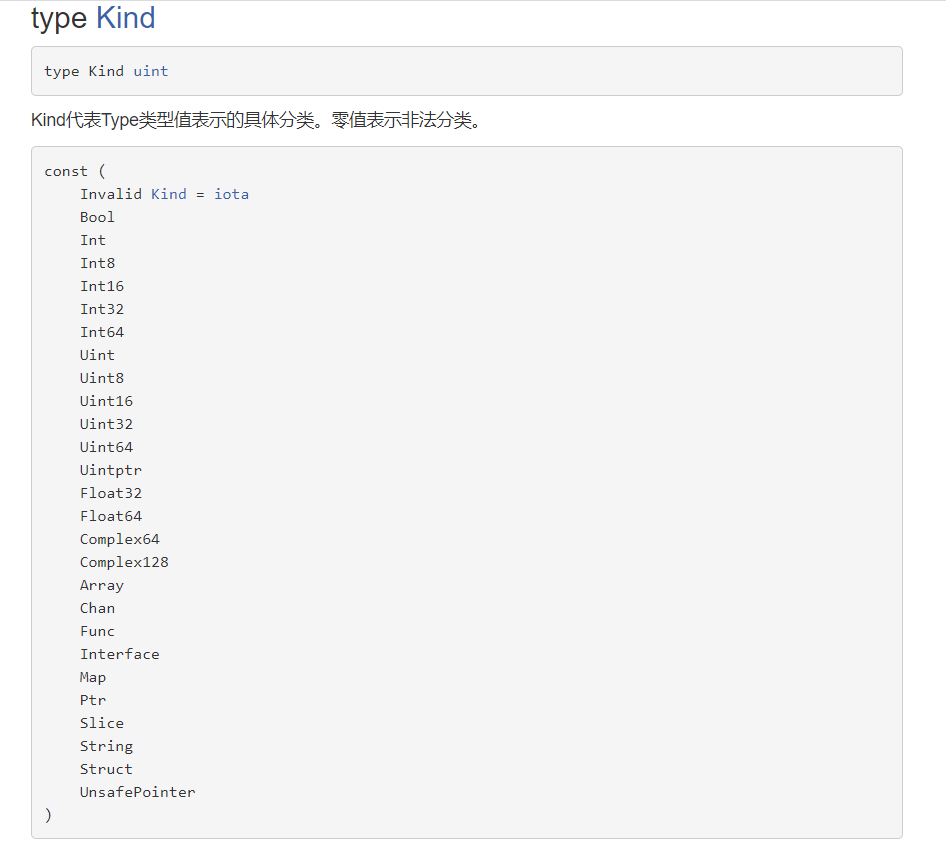
【3】代码:
go
package main

import(
        "fmt"
        "reflect"
)

//利用一个函数,函数的参数定义为空接口:
func testReflect(i interface{}){//空接口没有任何方法,所以可以理解为所有类型都实现了空接口,也可以理解为我们可以把任何一个变量赋给空接口。
        //1.调用TypeOf函数,返回reflect.Type类型数据:
        reType := reflect.TypeOf(i)

        //2.调用ValueOf函数,返回reflect.Value类型数据:
        reValue :=reflect.ValueOf(i)

        //获取变量的类别:
        //(1)reType.Kind()
        k1 := reType.Kind()
        fmt.Println(k1)

        //(2)reValue.Kind()
        k2 := reValue.Kind()
        fmt.Println(k2)

        //获取变量的类型:
        //reValue转成空接口:
        i2 := reValue.Interface()
        //类型断言:
        n,flag := i2.(Student)
        if flag == true {//断言成功
                fmt.Printf("结构体的类型是:%T",n)
        }

}

//定义学生结构体:
type Student struct{
        Name string
        Age int
}

func main(){
        //对结构体类型进行反射:
        //定义结构体具体的实例:
        stu := Student{
                Name : "丽丽",
                Age : 18,
        }
        testReflect(stu)
}
【4】Type和 Kind 的区别 Type是类型, Kind是类别,Type和Kind 可能是相同的,也可能是不同的. 比如:var num int = 10 num的Type是int , Kind也是int 比如:var stu Studentstu的 Type是 pkg1.Student , Kind是struct